Author name: learnifyeducation41

Blog

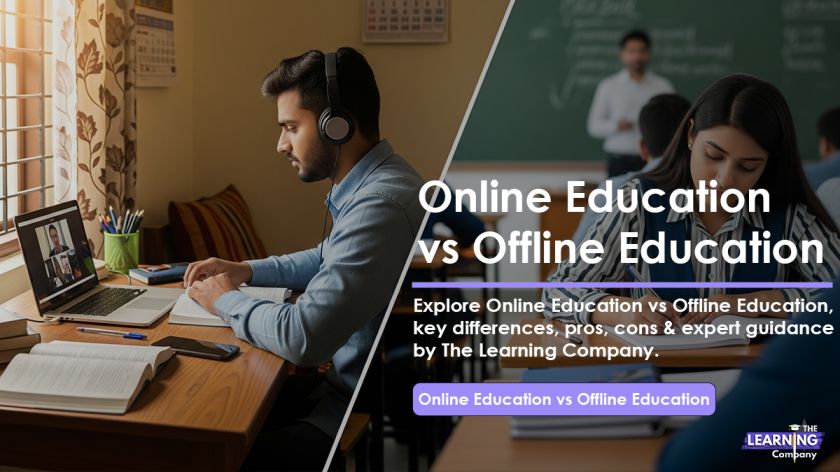
Online Education vs Offline Education: Which is Right for You?

Learning has always been the key to personal and professional growth. Whether we talk about building a career, improving skills, or gaining knowledge, learning plays a central role in shaping our lives. But in the last decade, the way we learn has changed completely. The debate of online education vs offline education is stronger than ever. While traditional classrooms have their own importance, online education has brought new possibilities that were once unimaginable. The question is — which one is better for you? In this blog, we will explore every angle of online and offline education: definitions, differences, pros and cons, real-life examples, and future trends. By the end, you’ll have a clear idea of which mode of learning fits your personal or professional goals. What is Online Education? Online education means studying through digital platforms like Zoom, Google Meet, or university portals. You don’t need to travel to a campus; instead, you can join from your home using a laptop or even a mobile phone. Examples include: A student from Delhi taking an MBA from Amity Online. A working professional from Bangalore learning data science from an international platform. A homemaker in Jaipur attending English communication classes online. The best part? Online education makes world-class universities and courses available to everyone, no matter where they live. What is Offline Education? Offline education is the traditional form of learning where teachers and students interact face-to-face in classrooms. This system has existed for centuries and is still considered the foundation of formal education. Examples include: School and college programs with daily classes. University lectures with labs, libraries, and physical exams. Training centers that require in-person attendance. Offline education is valued for its discipline, social environment, and practical exposure through labs, group projects, and extracurricular activities. Online Education vs Offline Education: Key Differences When we compare online education vs offline education, the differences go beyond just location. Here’s a detailed comparison: Flexibility and Time Management  Online: Classes can be live or recorded. Students decide when and where to study. Perfect for professionals and remote learners. Offline: Timetable is fixed. Students must follow the schedule and attend classes in person. Cost and Affordability  Online: No travel, hostel, or canteen expenses. Course fees are often lower. Offline: Additional expenses for accommodation, transport, and facilities. Learning Environment  Online: Quiet, personal space. But requires self-discipline and focus. Offline: Structured classroom with teacher supervision, which builds routine. Social Interaction  Online: Limited peer-to-peer engagement, often through chats or forums. Offline: Face-to-face discussions, group projects, and networking. Accessibility  Online: Global access. A student in India can study from a US or UK university. Offline: Restricted to physical presence; not always possible for distant learners. Advantages of Online Education Flexibility: Study anytime, anywhere. Variety: Choose from global courses across fields. Cost-effective: Save money on travel, hostel, and food. Best for working professionals: Continue your job while upgrading your skills. Access to recordings: Rewatch lectures anytime. Advantages of Offline Education Face-to-face interaction: Directly clear doubts with teachers. Structured learning: Routine builds discipline and focus. Better networking: Meet peers, professors, and alumni. Campus experience: Sports, labs, cultural events, and group studies. Hands-on learning: Best for courses like medicine, engineering, and sciences. Challenges of Online Education Requires high self-discipline. Internet issues can disturb classes. Less personal bonding with teachers. Screen fatigue due to long hours online. Challenges of Offline Education Higher expenses for transport, food, and housing. Fixed schedules can be stressful. Limited access for students living far away. Less exposure to global experts compared to online learning. Online Education vs Offline Education: Which is Better for Students? For school and college students, offline education provides personality development, teamwork, and discipline. But online education helps in extra learning. For example, a student preparing for competitive exams can use online platforms for coaching while continuing school offline. The best approach is to combine both: attend school for structured learning and use online platforms for additional skills. Online Education vs Offline Education: Which is Better for Working Professionals? For professionals, flexibility is key. Online education gives them the chance to upskill without leaving their jobs. For example: A software engineer can learn cloud computing online. A marketing professional can do an online MBA. A teacher can learn advanced teaching techniques digitally. Here, The Learning Company plays a huge role by helping professionals compare different online programs from top universities. They also provide free career counselling for working professionals, which removes confusion and saves time. Hybrid Learning: The Best of Both Worlds It’s not always a fight of online education vs offline education. Many institutions are offering hybrid models — where students attend some classes online and some offline. Example: MBA programs where lectures are online but exams and workshops are offline. This model combines flexibility with personal interaction, making it a strong option for the future. Expert Advice: How to Decide Between Online and Offline Check your career goals — Do you want a degree, or just skill development? Consider your lifestyle — Do you have time for daily classes? Check your budget — Online is usually more affordable. Learning style — Do you study better alone or with a group? Course type — Practical fields (like medicine) need offline labs; skill-based fields (like data science, digital marketing) work well online. Future of Education The future is not about online education vs offline education, but about integration. Artificial intelligence, virtual classrooms, and interactive platforms are making learning more personalized and engaging. Soon, students may choose a mix: Online for global access and flexibility. Offline for practical training and networking. This balance will ensure that education becomes more inclusive and accessible worldwide. Conclusion The debate of online education vs offline education has no single winner. Both have unique strengths and weaknesses. The real choice depends on your personal needs, career goals, and circumstances. If you’re a student, offline education builds your foundation while online courses can enhance your skills. If you’re a working professional, online education is usually the smarter option to continue learning without

The Importance of Career Planning
Blog

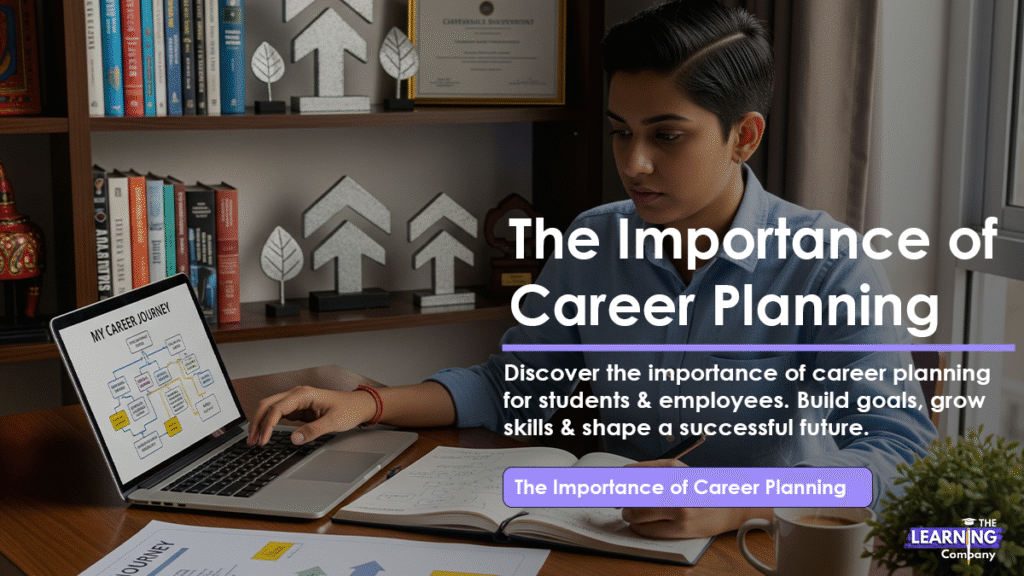
The Importance of Career Planning for Students & Job Professional

Career planning is one of the most valuable steps you can take for your future. No matter if you are a student just starting your journey, or an employee already working in an organization, having a clear plan can change the way you see your career. Many people think that success comes naturally over time, but in reality, those who succeed usually follow a well-thought-out career plan. In this blog, we will explore the importance of career planning, why it matters for both students and employees, and how you can start building your own plan today. What is Career Planning? Career planning is the process of setting short-term and long-term goals for your professional life and identifying the steps you need to achieve them. It is like preparing a map for your future career. Instead of moving blindly from one job to another, you take informed decisions that match your skills, interests, and life goals. A proper career plan answers questions like: What do I want to achieve in the next 5–10 years? Which skills should I learn to grow? Which industries or roles match my strengths? How can I balance personal growth with financial security? When you understand the importance of career planning, you are better prepared to face challenges and take advantage of opportunities. Why Career Planning Matters Today The world of work is changing faster than ever before. New technologies, industries, and skills are constantly emerging. Jobs that were in demand ten years ago may no longer exist, while new roles are created every year. Without career planning, you may find yourself stuck in an outdated role or struggling to keep up. Some major reasons why career planning is important today: Job competition is high – Companies look for candidates who are clear about their goals. Skills are changing – You need to plan what to learn next to stay relevant. Work-life balance matters – Career planning helps you choose paths that support your lifestyle. Long-term growth – Planning avoids confusion and gives you direction. The Importance of Career Planning for Students For students, career planning can be life-changing. This is the stage where decisions about courses, skills, and first jobs are made. Without guidance, many students end up in fields that don’t match their interests or talents. Benefits for Students: Clarity about goals – Students understand which stream or course to choose. Better college and course selection – Instead of guessing, they make informed choices. Skill development – They can focus on skills that are in demand in their chosen field. Confidence – With a clear plan, students feel more confident about their future. For example, a student interested in technology should explore IT courses, internships, and certifications early. On the other hand, someone who loves creativity may explore design, media, or writing-related careers. This is why the importance of career planning for students cannot be ignored — the right start often leads to a successful journey. The Importance of Career Planning for Employees Employees who are already working may think career planning is only for fresh graduates, but that’s not true. In fact, employees who don’t plan often face stagnation in their careers. Benefits for Employees: Promotions and growth – A clear plan helps in identifying the skills needed for higher roles. Job satisfaction – Employees who plan feel more fulfilled because they work toward a purpose. Switching careers – Many employees want to move into new industries. Career planning makes this transition smoother. Financial security – Planning helps in choosing opportunities that provide stability and growth. For example, an employee working in sales may plan to move into management. With proper career planning, they can work on leadership and communication skills to make this transition successfully. This highlights the importance of career planning for employees, as it ensures long-term career stability and personal satisfaction. Steps to Start Your Career Planning Self-Assessment – Understand your strengths, weaknesses, and interests. Set Goals – Decide your short-term (1–3 years) and long-term (5–10 years) goals. Research – Explore industries, job roles, and future opportunities. Skill Development – Enroll in courses, workshops, or certifications. Networking – Connect with mentors, professionals, and communities. Regular Review – Career planning is not a one-time activity. Keep updating your goals as life changes. How The Learning Company Can Help Planning your career can feel overwhelming when you try to do it alone. This is where expert guidance makes a difference. The Learning Company provides free career counselling for working professionals, helping them evaluate their career goals, skill gaps, and growth opportunities. They also guide students in choosing the right courses and building a long-term roadmap. Whether you are a student unsure of your next step or an employee looking for growth, The Learning Company can simplify the process for you. Conclusion In today’s fast-changing world, having a strong career plan is not just an option — it’s a necessity. Students need it to start their journey with confidence, and employees need it to stay relevant, grow, and find satisfaction in their work. Understanding the importance of career planning will help you stay ahead, achieve your goals, and enjoy a fulfilling career. If you are ready to take control of your future, start planning today — and remember, guidance from experts like The Learning Company can make your journey smoother and more successful. Book Free Counseling

Blog

How to Prepare for a Career Change

Changing your career is a big decision. It can feel exciting, but at the same time, it may bring a lot of confusion and stress. Many professionals reach a stage in life where they want something new — maybe better growth, more passion, or a work-life balance that their current job doesn’t give. If you are thinking about a new path, then knowing how to prepare for a career change will make the journey smoother and less risky. In this blog, we will cover simple, practical steps to plan a career transition. The aim is to guide you in a way that feels realistic and achievable. Why Do People Think About a Career Change? Before learning how to prepare for a career change, it’s important to understand why professionals even think of it. Some common reasons include: Lack of growth opportunities Feeling stuck or bored at work High stress and burnout Desire for higher income Passion for a different industry Work-life balance issues When you clearly know your reason, your preparation becomes stronger. Step 1: Self-Assessment – Know Yourself First The first step in how to prepare for a career change is to know your own strengths and weaknesses. Ask yourself: What are my current skills? Which type of work makes me happy? Am I ready to learn new skills? Make a list of what you love doing, and what you don’t enjoy. This will help you avoid repeating the same mistakes in your new career. Step 2: Research Career Options Jumping blindly into a new field is risky. Research is the most important part of how to prepare for a career change. Look into: Industries that are growing Job roles that match your skills Future scope of the career Average salary and lifestyle changes Talking to professionals already working in that industry can also give you real insights. Step 3: Upgrade Your Skills Some careers may only need short-term certification, while others may require a degree. For example: Digital marketing and data analytics need certifications Teaching and psychology may need higher education If you are unsure which skill or course to choose, you can connect with The Learning Company, which offers free career counselling for working professionals. Their guidance can save you time and effort. Step 4: Networking Matters Networking is a hidden power in career growth. A big part of how to prepare for a career change is connecting with the right people. You can: Join LinkedIn groups Attend webinars or industry events Talk to old colleagues who shifted careers Networking often opens job opportunities that are never advertised online. Step 5: Start Small Before the Big Leap Quitting your current job overnight is risky. Instead, try: Freelancing in your new field Doing part-time projects Volunteering This way, you get real experience before fully committing. It also helps you confirm if this new path truly suits you. Step 6: Prepare Financially Switching careers may mean a temporary salary drop. While learning how to prepare for a career change, don’t ignore financial planning. Save money for at least 6 months of expenses. This backup will reduce stress and allow you to focus on your new career. Step 7: Create a Personal Brand Today, companies don’t just look at your resume — they also check your online presence. Build a personal brand: Update your LinkedIn profile Share your learning journey online Write about industry topics This will show recruiters that you are serious about your new career path. Step 8: Stay Mentally Strong One of the most ignored but vital parts of how to prepare for a career change is mental preparation. Changing careers may feel like starting from zero, and sometimes, people around you may not support your decision. Stay confident, remind yourself why you are making this move, and keep going. How The Learning Company Can Help Career changes are tough, but you don’t have to walk the path alone. The Learning Company offers free career counselling for working professionals. They help you evaluate your goals, identify skill gaps, and suggest courses or career roadmaps. This kind of guidance makes your journey less confusing and more focused. Final Thoughts Learning how to prepare for a career change is about clarity, patience, and planning. It is not just about leaving one job and entering another; it is about building a future that matches your skills, interests, and lifestyle goals. With the right preparation — from self-assessment and skill building to networking and financial planning — you can make this transition smooth and successful. If you feel stuck, don’t hesitate to take help. Guidance from experts, like the counsellors at The Learning Company, can be the turning point in your career journey. Book Free Counseling

Blog

High Salary Courses After 12th Science Biology What to do after 12th

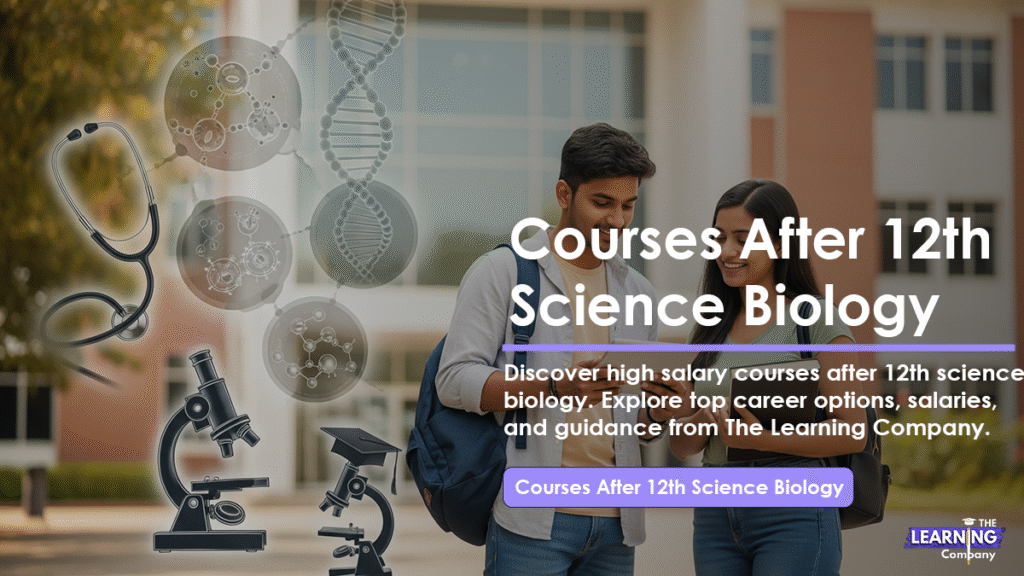
Choosing the right career after completing your 12th with a science biology background is one of the most important decisions you’ll make in life. Many students often feel confused about what to do next. If your goal is to build a successful career with a good income, you’ll be glad to know there are several high salary courses after 12th science biology that can lead to financially rewarding and fulfilling careers. In this guide, we will discuss the top courses you can choose, what career opportunities they offer, and why they are considered high-paying. The goal is to help you make an informed decision so you can confidently plan your future. Courses After 12th Science Biology If you have studied Physics, Chemistry, and Biology (PCB) in 12th grade, you already have a strong base for multiple career options in medical, paramedical, research, and even non-medical fields. Here are some major career streams you can explore: Medical courses (like MBBS, BDS, BAMS) Paramedical courses (like Physiotherapy, Radiology, Nursing) Biotechnology and research Allied health sciences Management or law courses related to healthcare The choice depends on your interest, skill set, and how many years you want to invest in studies. After 12th Science Biology Courses List Here’s a list of popular and in-demand courses you can consider after your 12th in biology: MBBS (Bachelor of Medicine, Bachelor of Surgery) BDS (Bachelor of Dental Surgery) BAMS (Bachelor of Ayurvedic Medicine and Surgery) BHMS (Bachelor of Homeopathic Medicine and Surgery) B.Sc. Nursing BPT (Bachelor of Physiotherapy) B.Sc. in Biotechnology B.Sc. in Microbiology B.Sc. in Forensic Science Pharmacy (B.Pharm) Genetics and Molecular Biology B.Sc. Agriculture All of these courses have the potential to lead to stable jobs, but some are known for offering higher salary packages depending on your skills, location, and demand. Best Courses After 12th Science Biology Let’s talk about some of the best high salary courses after 12th science biology and why they stand out. 1. MBBS – The Evergreen Choice MBBS remains the most preferred choice for students who want to become doctors. Although it takes 5.5 years to complete, the career opportunities and earning potential are unmatched. After specialization, doctors in India can earn from ₹8 LPA to ₹20 LPA or even higher. 2. BDS – Dental Surgeon Dentistry is another lucrative medical profession. With increasing awareness about oral health, skilled dentists can earn a high income through private practice or working in reputed hospitals. 3. BAMS – Ayurveda and Alternative Medicine With the growing demand for holistic healthcare, Ayurvedic doctors are in demand both in India and abroad. 4. BPT – Physiotherapy Physiotherapists work in hospitals, sports organizations, and rehabilitation centers. Experienced professionals can earn an excellent salary, especially in metro cities. 5. B.Sc. in Biotechnology This is an excellent choice if you’re interested in research and innovation. Biotechnology experts are needed in pharmaceuticals, agriculture, and genetic research. What to Do After 12th Science Biology Many students feel unsure about which path to choose after finishing their 12th in science biology. The best approach is to: Identify your interests (medical, research, or applied sciences) Consider the duration and cost of the course Look at the job market demand and salary trends Seek expert guidance If you’re still confused, you can reach out to The Learning Company. They provide free career counselling for working professionals and students, helping you choose the right course based on your goals and strengths. Top High Salary Courses After 12th Science Biology If you enjoy teaching and mentoring, MCom can open the door to a rewarding career in education. Lecturer/Professor – Teaching commerce, accounting, or finance in colleges after clearing NET/SET. School Commerce Teacher – Teaching Business Studies, Economics, and Accountancy at school level. Corporate Trainer – Conducting workshops on financial skills, taxation, or business planning. 5. Entrepreneurship & Self-Employment Here are some of the most rewarding courses that can help you earn well: Course Name Duration Average Starting Salary Career Opportunities MBBS 5.5 years ₹6–10 LPA Doctor, Surgeon, Specialist BDS 5 years ₹4–8 LPA Dentist, Orthodontist BPT 4.5 years ₹3–6 LPA Physiotherapist, Rehab Expert Biotechnology 3 years ₹3–7 LPA Researcher, Biotech Analyst Pharmacy 4 years ₹3–5 LPA Pharmacist, Drug Analyst Forensic Science 3 years ₹3–6 LPA Forensic Expert, Crime Lab Analyst Tips to Choose the Best Course for You Match with your passion – Don’t choose a course only for money; consider what excites you. Understand the commitment – Some high salary courses require years of study and training. Research career growth – Look at where the field will be in 5–10 years. Final Thoughts Your 12th science biology background opens the door to many high salary courses after 12th science biology. Whether you want to be a doctor, researcher, physiotherapist, or work in biotechnology, there is no shortage of opportunities. The key is to pick a course that matches your interest and long-term career vision. Remember, the right guidance at this stage can save you from years of confusion. That’s why taking help from career counselling services like The Learning Company, which offers free career guidance for students and professionals, can be a smart first step. Book Free Counseling

Blog

Career Options for Arts Students, Courses for Art Students

Choosing the right career options for arts students is not always easy. Many people think arts students have fewer opportunities compared to science or commerce students — but that’s not true. Today, arts students can explore a wide range of courses, jobs, and career paths that are equally rewarding. If you have completed your 12th in arts, this guide will help you understand the best career options for arts students, what courses you can pursue, and the kinds of jobs you can get in the future. Courses for Art Students Arts students have the advantage of choosing from both creative and professional fields. Here are some popular courses for art students after 12th: Bachelor of Arts (BA) – Offers specializations in fields such as English, Political Science, Psychology, Sociology, History, and Economics. Bachelor of Fine Arts (BFA) – An ideal choice for students passionate about painting, sculpture, and various applied art forms. Bachelor of Design (B.Des) – Great choice for careers in fashion, interior, or graphic design. Bachelor of Journalism and Mass Communication (BJMC) – For those who want to work in media, TV, radio, or digital journalism. Bachelor of Hotel Management (BHM) – Ideal for students interested in hospitality and tourism. Law (BA LLB) – A professional degree that can lead to careers in legal services, judiciary, or corporate law. Tip: While choosing a course, think about your skills, interests, and long-term career goals. If you are still unsure, you can connect with The Learning Company for free career counselling, especially if you are a working professional looking for the right study path. Jobs for Arts Students Many students ask — “What are the best jobs for arts students?” The truth is, you can work in almost every sector depending on your qualifications and skills. Here are some options: Content Writer / Copywriter – Write blogs, articles, scripts, and social media content. Graphic Designer – Create visual designs for brands, websites, and advertising. Teacher / Lecturer – Teach school or college-level students in your chosen subject. Social Media Manager – Handle social media accounts for companies or influencers. Civil Services – Prepare for UPSC or state-level administrative services. Public Relations Officer. NGO / Social Work – Work in welfare projects, community service, or policy-making. Can Arts Student Do BCA? Many people wonder — can arts student do BCA? Yes, you can, but with certain conditions. Most universities require students to have studied Mathematics or Computer Science in 12th grade to be eligible for BCA (Bachelor of Computer Applications). However, some private universities accept arts students without math, provided they clear an entrance test. BCA can open doors to careers in software development, IT services, data analysis, and web development. If you have an interest in technology, this is a great option to consider. Can Arts Student Do BBA? If you are interested in business, marketing, or management, you might ask — can arts student do BBA? Absolutely yes! BBA (Bachelor of Business Administration) is open to students from all streams, including arts. It includes key areas such as business management, finance, marketing, and entrepreneurial skills. After completing BBA, you can get jobs in corporate companies, start your own business, or continue your studies with an MBA. Can Arts Student Do MBA? The next common question is — can arts student do MBA? Yes, arts students can definitely pursue an MBA after graduation. In fact, many top MBA colleges in India have students from arts backgrounds who excel in management studies. To get into a good MBA program, you usually need to clear entrance exams like CAT, XAT, or MAT. MBA specializations – Yes Marketing, Finance, Human Resources, Operations, and International Business. MBA graduates can work as managers, business analysts, consultants, or entrepreneurs. If you need help choosing the right MBA specialization, The Learning Company offers free counselling for working professionals to guide them in making career decisions. Other Career Options for Arts Students Apart from the popular courses mentioned above, here are some more career options for arts students: Animation & Multimedia – Careers in animation films, video games, and special effects. Event Management – Planning and organizing corporate or personal events. Travel & Tourism – Work in travel agencies, airlines, or tourism boards. Foreign Language Expert – Learn languages like French, German, Japanese, or Spanish and work as a translator or interpreter. Photography & Videography – Work as a professional photographer, filmmaker, or editor. Psychology & Counselling – Become a psychologist, therapist, or counsellor. How to Choose the Right Career Path Choosing the best career option depends on your: Interest – What subjects or activities excite you? Skills – What are you naturally good at? Market Demand – Which careers are growing and have better job opportunities? If you are confused, don’t worry — guidance can make all the difference. The Learning Company helps students and working professionals with free career counselling, skill-gap analysis, and course recommendations. Final Thoughts Arts is not a “lesser” stream. With the right guidance and the right choices, arts students can build successful and fulfilling careers in multiple industries. Whether you choose traditional courses like BA and LLB or modern options like BBA, BCA, and MBA, the key is to follow your passion and keep learning. If you are exploring career options for arts students and need clarity, reach out to The Learning Company for expert, free counselling — it might be the first step toward your dream career. Book Free Counseling

Importance of Value Education
Blog

Importance of Value Education, What is Value Education

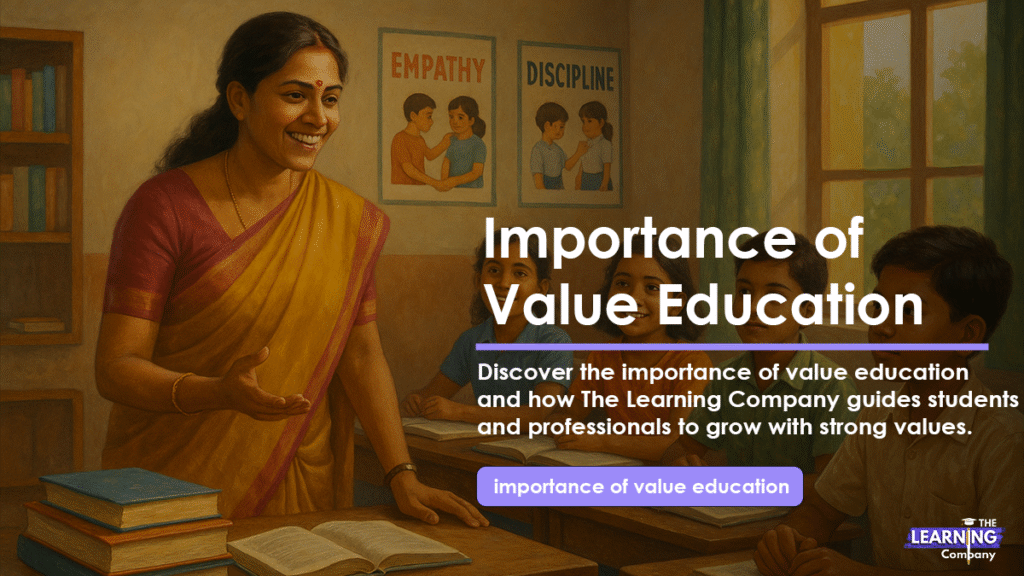
We all want to do well in life — get good jobs, earn well, and live happily. But there’s something even more important than just skills and degrees — values. That’s where value education comes in. It’s about learning honesty, kindness, discipline, and responsibility. These values guide our actions and decisions, both in our personal and professional lives. The Learning Company believes that success is not only about what you achieve but also about how you achieve it. That’s why they focus on helping students and professionals understand the importance of value education along with career planning. What is Value Education Value education means learning and teaching good values like honesty, respect, caring for others, and being responsible. It’s not just a school subject — it’s a way of living. When you have value education, you learn to: Treat people with respect. Be honest in every situation. Take responsibility for your actions. Help others when they need support. The Learning Company always reminds students that education is incomplete without good values. Need of Value Education In today’s world, competition is high, and everyone wants to get ahead. But without values, success can feel empty. That’s why the need of value education is so important. It helps by: Guiding us to make the right choices. Building trust in relationships. Creating a better and more peaceful society. When The Learning Company gives career advice, they also highlight the need for values to ensure long-term growth and happiness. Types of Value Education There are different types of value education, each focusing on a specific area of life: Moral Values – Honesty, fairness, and truthfulness. Civic Values – Responsibility towards society and the country. Cultural Values – Respect for traditions and diversity. Environmental Values – Caring for nature and resources. Personal Development Values – Self-discipline, confidence, and goal-setting. The Learning Company’s guidance helps students and professionals grow in all these areas. Value Education – Benefits for Students & Professionals Value education is not only for children — it benefits professionals too. For Students: Improves focus on studies. Encourages teamwork and respect for classmates. Builds confidence to face challenges. For Professionals: Improves leadership and decision-making. Builds trust with colleagues and clients. Supports career growth and respect in the workplace. The Learning Company often sees that those who combine skills with strong values go much further in life. What is Value Education in Human Values When we talk about value education in human values, we mean applying morals in everyday life. Examples include: Speaking the truth, even if it’s hard. Understanding and respecting other people’s feelings. Admitting mistakes and learning from them. These human values are what make a person truly successful, beyond money or titles. What is the Need for Value Education The world today faces problems like corruption, inequality, and environmental damage. The need for value education is greater than ever to solve these challenges. It helps in: Building good character. Encouraging peaceful and respectful living. Preparing people to be responsible citizens of the world. The Learning Company believes values are the foundation of a meaningful life. How The Learning Company Supports Value Education – More Than Just Career Guidance The Learning Company is more than a career counselling platform. They guide students and professionals not only in choosing the right course or college but also in building the right mindset, ethics, and sense of purpose. They believe: Mindset – Stay positive and open to learning. Ethics – Be fair and honest in all situations. Purpose – Know why you are working towards a goal. And yes — The Learning Company offers free career counselling for working professionals, making it easy for anyone to take the first step towards a bright future. Conclusion The importance of value education is clear — it shapes who we are and how we live. Skills may get you a job, but values help you grow, earn respect, and live with pride. The Learning Company proves that the best career guidance is the one that combines knowledge with values. If you want to choose the right path for your future while becoming a responsible and value-driven person, The Learning Company is here to help. Book Free Counseling

Best Courses After 12th
Blog

Best Courses After 12th: Science, Commerce with High Salary

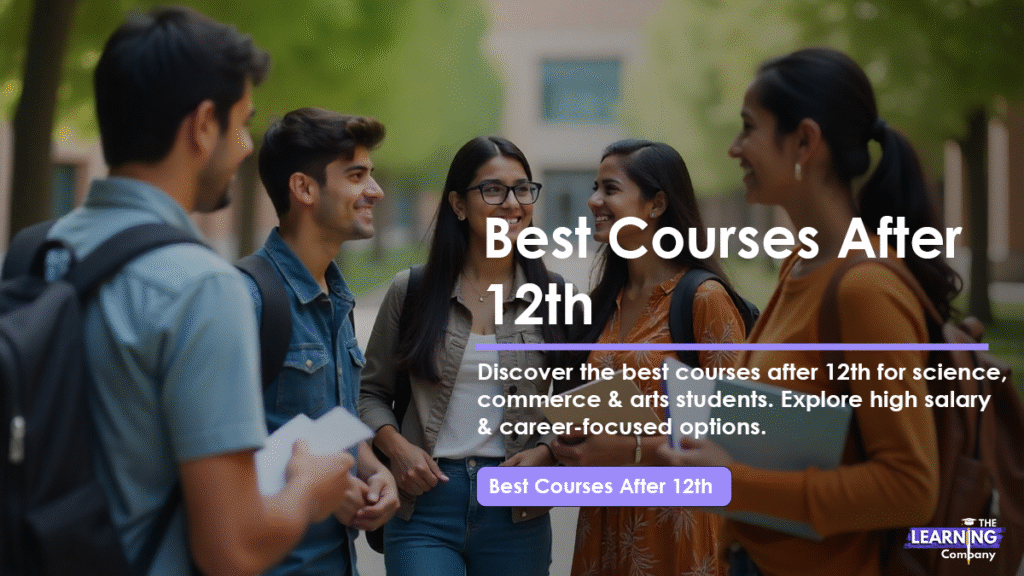
Completing Class 12th is a major milestone in every student’s life. But what comes next can feel confusing or even overwhelming. With so many career options, how do you choose the best courses after 12th? Whether you are from Science, Commerce, or Arts stream — this blog is here to guide you through the most in-demand, high-paying, and future-proof courses available today. We’ll also help you answer popular questions like: What course is best after 12th? What are the best job courses after 12th? Which are the best salary courses after 12th? After 12th, which course is best for the future? Let’s explore the best courses after 12th for all streams — including short-term, medical, business, and science-related programs. And remember, if you’re still unsure, The Learning Company offers free career counselling for students and working professionals to help you make informed decisions. Best Courses After 12th Science If you studied Physics, Chemistry, and Maths or Biology, you’re eligible for a variety of technical and non-technical careers. some of the best courses after 12th science: For PCM Students (Physics, Chemistry, Maths): Engineering (B.Tech / BE) – Specializations in Computer Science, Mechanical, Electrical, Civil, AI, and more. Architecture (B.Arch) – For those interested in designing buildings and spaces. BCA (Bachelor of Computer Applications) – Ideal for students who want to enter the tech field without Maths. For PCB Students (Physics, Chemistry, Biology): MBBS / BDS / BAMS / BHMS – Traditional medical routes. B.Sc. in Biotechnology, Zoology, Botany, Microbiology – Great for research or laboratory roles. Bachelor of Physiotherapy (BPT) – Growing demand in hospitals, clinics, and sports therapy. These options are highly valued and set a solid foundation for further specialization. Best Courses After 12th with High Salary Everyone dreams of a career that brings both satisfaction and financial growth. Here are some best courses after 12th with high salary potential: MBBS (Doctor) – Healthcare professionals continue to be in demand. Engineering (especially in Computer Science, AI, Robotics, and IT) BBA + MBA (Management roles) – Salaries grow rapidly with experience. Law (BA LLB) – High earning potential in corporate, civil, or criminal law. CA (Chartered Accountant) – One of the top-paying roles in finance and accounting. These are also among the best job courses after 12th, offering long-term financial security and growth. Best Medical Courses After 12th Without NEET Not everyone wants to or can crack NEET, and that’s completely okay.  best medical courses after 12th without NEET: B.Sc. Nursing Bachelor of Physiotherapy (BPT) B.Sc. in Radiology, Anesthesia, or Dialysis Technology Medical Lab Technology (MLT) B.Sc. Nutrition & Dietetics These programs lead to respected careers in hospitals, clinics, diagnostics, and wellness sectors — no NEET required. Best Biology Courses After 12th Students who had Biology but don’t want to become doctors still have several options. Here are the best biology courses after 12th: B.Sc. Biotechnology B.Sc. Genetics / Microbiology B.Sc. Environmental Science B.Sc. Agriculture B.Sc. Zoology or Botany These courses are best suited for those interested in lab research, agriculture, food sciences, and environmental conservation. Best Graduation Courses After 12th Many students ask, “Which is the best graduation course after 12th?” Here are some top choices across all streams: BBA (Bachelor of Business Administration) B.Com (General / Hons) BA (Bachelor of Arts) in English, Psychology, Sociology, etc. B.Sc. in various specializations BCA (Bachelor of Computer Applications) All these are solid graduation programs that can lead to post-graduate studies, jobs, or entrepreneurship. What is Best Course After 12th Commerce? Commerce students have a wide range of career paths. So, what is best course after 12th commerce? B.Com (General / Hons) – Foundation of business, finance, and accounting. CA (Chartered Accountancy) – Best for high salary and respect in finance. CS (Company Secretary) – For those interested in legal and administrative roles. BBA (General or with specializations like Finance, Marketing, HR) Bachelor in Economics – Perfect for policy-making or data-focused roles. Digital Marketing / E-Commerce – Fast-growing and in-demand. These courses offer stability, financial growth, and entrepreneurial opportunities. Best Medical Courses After 12th with High Salary If you’re passionate about medicine and also looking for financial rewards, here are the best medical courses after 12th with high salary: MBBS / BDS (Dentistry) – High earning and noble professions. Pharmacy (B.Pharm) – Career in pharma companies or entrepreneurship. BPT (Physiotherapy) – High demand in sports and wellness industry. B.Sc. in Radiology or Medical Imaging – Skilled technicians are well-paid. BAMS / BHMS / BNYS – Alternative medicine with growing popularity. These courses offer both respect and rewarding paychecks over time. Best Short Term Courses After 12th Not everyone wants a 3–5 year college program. Many students want to upskill quickly. Here are the best short term courses after 12th: Digital Marketing Graphic Design / UI-UX Design Foreign Language Courses (French, German, Spanish) Web Development / App Development Tally & Advanced Excel for Accounting Content Writing / SEO Photography / Videography These short-term programs (3 to 12 months) can land you freelance gigs, internships, or even full-time jobs. Best Course for Business After 12th If you’re someone with entrepreneurial dreams or a passion for starting your own company, these are the best course for business after 12th: BBA (Entrepreneurship / Family Business Management) B.Com with Business Analytics Bachelor in International Business Diploma in Business Administration Start-up Incubation Programs (short-term) These courses help build your knowledge of marketing, finance, operations, and leadership — skills every entrepreneur needs. After 12th Which Course is Best for Future? Still wondering after 12th which course is best for future? Field Top Future Courses Technology B.Tech (AI, Robotics), BCA Medical & Healthcare MBBS, BPT, Nursing Business BBA, B.Com, MBA Finance CA, CS, CFA Creative Fields Designing, Digital Marketing, Content Creation Public Services BA + UPSC, B.Sc. + State Exams Choosing the right course depends on your interest, ability, and long-term goals — not just trends. And if you’re confused, don’t worry — help is available.  How The Learning Company Can Help At The Learning Company, thousands of students

Is Online MBA Valid in India? Online MBA vs Distance MBA
Blog

Is Online MBA Valid in India? Online MBA vs Distance MBA

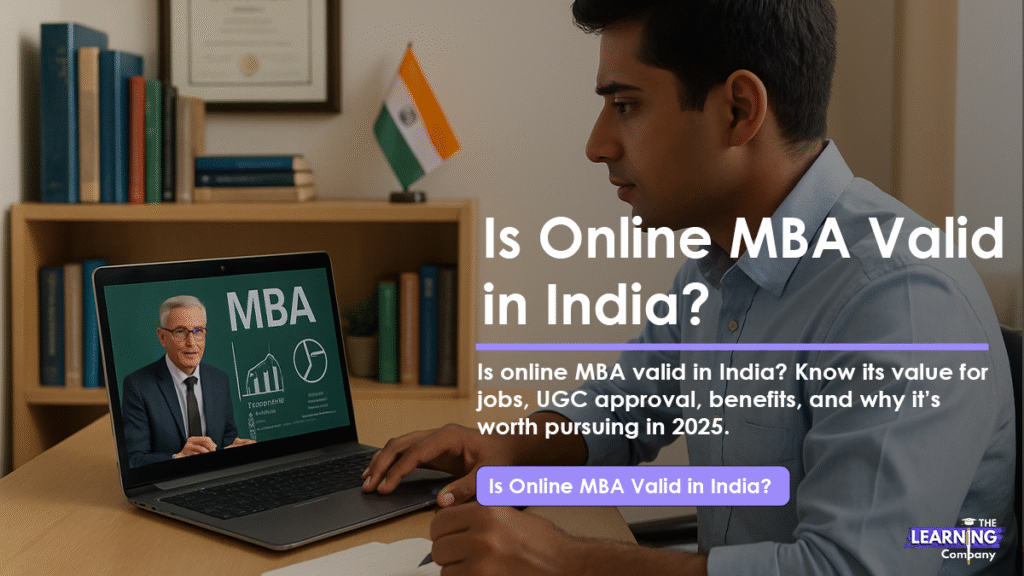
In recent years, online learning has become a major part of higher education in India. One of the most popular programs is the Online MBA. But the main question remains — is online MBA valid in India? The answer is yes, it is valid, provided you choose a recognized university. Let’s explore its acceptance, scope, and why it is becoming a preferred choice in 2025. Is Online MBA Valid in India for Government Jobs? A common question among candidates is whether an online MBA is accepted for government employment in India. The answer is yes — as long as the degree is awarded by a university that has UGC entitlement or AICTE approval, it is recognized for most government examinations and promotions. Government sectors, public sector undertakings (PSUs), and even competitive exams like UPSC accept online MBA degrees from recognized institutions. Always check the eligibility criteria of the specific exam, but in general, an accredited online MBA is treated the same as a regular MBA for government roles. Is Online MBA Valid in India for Private Sector Jobs? The private sector values skills and expertise over the learning mode. So, is online MBA valid in India for private companies? Absolutely yes,  Many leading companies, MNCs, and startups hire online MBA graduates because they demonstrate time management and self-discipline while balancing work and studies. With practical exposure and live projects, online MBA programs are now as competitive as regular ones. How Valid Is an Online MBA in India Compared to a Regular MBA? An online MBA from a UGC-recognized university is considered legally equivalent to a regular MBA in terms of validity and acceptance. The difference lies in experience: Regular MBA gives campus life, face-to-face networking, and in-person workshops.   Online MBA gives flexibility, lower cost, and digital resources from anywhere. If you are working or cannot relocate, an online MBA is both valid and practical. Is an Online MBA as Valuable as a Regular MBA in India? One of the most critical factors in answering is online MBA valid in India is the accreditation of the college.  Before taking admission, check: UGC recognition NAAC grade of the university AICTE approval (if required) Why Is Online MBA Gaining More Validity in India Post-COVID? Since COVID-19, online education has gained huge acceptance. Many top Indian and global universities now offer high-quality online MBA programs with live classes, interactive sessions, and placement support. Employers have also shifted their perspective. Remote work and online learning are now seen as normal and effective ways of gaining knowledge and skills. This change has made online MBAs more valid and valuable than ever. Is Online MBA in India Worth It in 2025? Reasons why it’s worth it: Legally recognized degree if from UGC-approved university Affordable fees compared to full-time MBA Flexibility to balance work and studies Access to case studies, simulations, and global faculty With increasing demand for skilled managers in India, an online MBA offers strong career growth opportunities. Online MBA vs Distance MBA Aspect Online MBA – Pros Online MBA – Cons Distance MBA – Pros Distance MBA – Cons Learning Mode Live interactive classes with recordings for flexibility Requires stable internet and scheduled attendance Offline study possible anytime at your own pace Mostly self-study with limited faculty interaction Interaction Real-time discussions with faculty and peers Session timings may clash with work schedules Freedom from fixed class timings Minimal live interaction and networking opportunities Flexibility Attend classes from anywhere with internet access Time management required for live sessions Fully flexible, no fixed class schedules Less engaging due to lack of real-time classes Recognition Fully valid if from UGC-approved university Some employers may prefer regular MBA experience Valid if UGC-approved and accepted for jobs Perceived as less interactive compared to online MBA Placement Support Many universities offer dedicated placement assistance Quality of placement support depends on institute Some institutes provide alumni support and guidance Placement support not as structured as online MBA From this table, it’s clear that an online MBA offers a more engaging and practical learning experience, making it more valuable in today’s digital era. Final Verdict – Is Online MBA Valid in India? To sum up, is online MBA valid in India? Yes, it is valid, recognized, and accepted across industries if done from an accredited university. It is a flexible, affordable, and smart choice for students, fresh graduates, and working professionals looking to grow their careers. How The Learning Company Can Help If you are still unsure which online MBA programs are valid in India, The Learning Company offers free career counselling for working professionals. Their expert guidance can help you pick the right university, avoid unrecognized courses, and build a strong career plan. Book Free Counseling

BA Course details
Courses

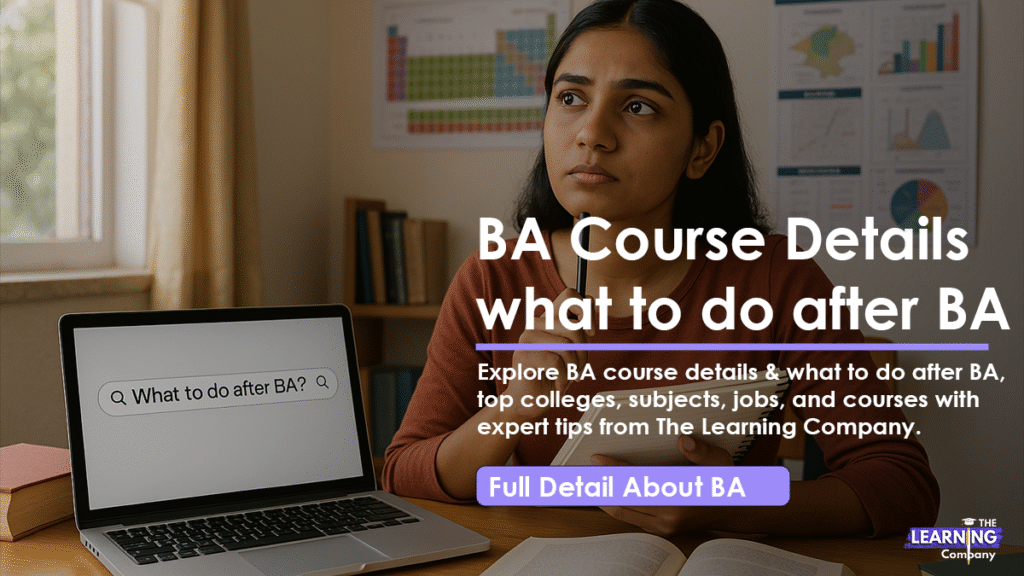
BA Course details: What to do after BA? Can I do MBA after BA

If you have recently completed or are planning to pursue a Bachelor of Arts (BA), you may be wondering: what comes next? In this blog, we will explore BA course details & what to do after BA, along with career options, higher education paths, job opportunities, and much more. This guide will help you make informed decisions about your future, especially if you’re aiming for high-paying or government jobs, or thinking about further studies like an MBA.+6 BA Full Form: BA Course Details The full form of BA is Bachelor of Arts. It is a popular undergraduate degree program offered in various disciplines such as History, Political Science, English, Sociology, Economics, Psychology, and more. BA Course Details The BA course details are essential to understand before enrolling. BA is usually a 3-year undergraduate degree program in India. It is available in both regular and online modes through various universities. It provides foundational knowledge and opens multiple career and academic opportunities. BA How Many Years? BA Course details you should know that the BA degree typically spans three years, divided into six semesters. BA Course Subjects The subjects in a BA course vary based on the chosen specialization. However, some common subjects include: English Literature History Political Science Sociology Psychology Economics Public Administration Top BA Colleges in India. BA Course details To help you with your decision on where to study, here are some top BA colleges in India that offer excellent programs: Amity University (Online)   Fees: INR 16,500 per semester Full Course Fee: INR 99,000 Discounted Fee: INR 94,050 Manipal University, Sikkim   Fees: INR 12,500 per semester Full Course Fee: INR 75,000 Vivekanand Global University   Fees: INR 10,500 per semester Full Course Fee: INR 63,000 These institutions offer quality education and flexibility, especially useful for students and working professionals trying to balance studies with life. What to Do After BA Now comes the main question — what to do after BA? If you’re reading this blog for BA course details & what to do after BA, this section is especially important. You can: Pursue higher studies (MBA, MA, LLB, etc.) Start working in private or government sectors Learn new-age skills like digital marketing or data analytics The decision depends on your interests, strengths, and career goals. High Paying Jobs After BA A common myth is that BA graduates don’t get lucrative jobs — but that’s not true. There are plenty of high paying jobs after BA, such as: Digital Marketing Executive HR Executive Public Relations Officer Business Development Associate Content Writer / Editor Social Media Manager With the right skills and experience, BA graduates can build successful and high-income careers. Can I Do MBA After BA? Yes, you definitely can!Here’s the good news — a BA graduate is eligible for MBA programs in: Marketing Human Resources Finance International Business Operations You’ll need to appear for entrance exams like CAT, MAT, or GMAT to join top MBA colleges. Govt Jobs After BA If you are aiming for a stable and respected career, govt jobs after BA are a great option. You can apply for: UPSC Civil Services (IAS, IPS, etc.) SSC CGL Banking exams like IBPS PO, SBI PO State PCS RRB NTPC (Railways) CDS (for defense services) Government jobs are competitive but offer job security, good salary, and other benefits. Top 10 Courses After BA If you’re wondering what to do after BA, here are the top 10 courses after BA that can help you build a bright future: MBA (Master of Business Administration) MA (Master of Arts) LLB (Bachelor of Law) B.Ed (Bachelor of Education) MFA (Master of Fine Arts) MSW (Master of Social Work) PG Diploma in Journalism & Mass Communication Data Analytics or Data Science Courses Digital Marketing Certification Foreign Language Courses Choosing any of these based on your interest can take your career to the next level. Final Thoughts Choosing what to do after BA can feel overwhelming, but the right information helps you feel confident. From understanding BA course details to selecting the right job or further education, every step counts. Whether you’re dreaming of a government job, considering an MBA after BA, or exploring high-paying roles — your BA degree is a strong starting point. Stay curious, invest in learning, and consider reaching out to professionals like The Learning Company for guidance. Book Free Counseling

Courses

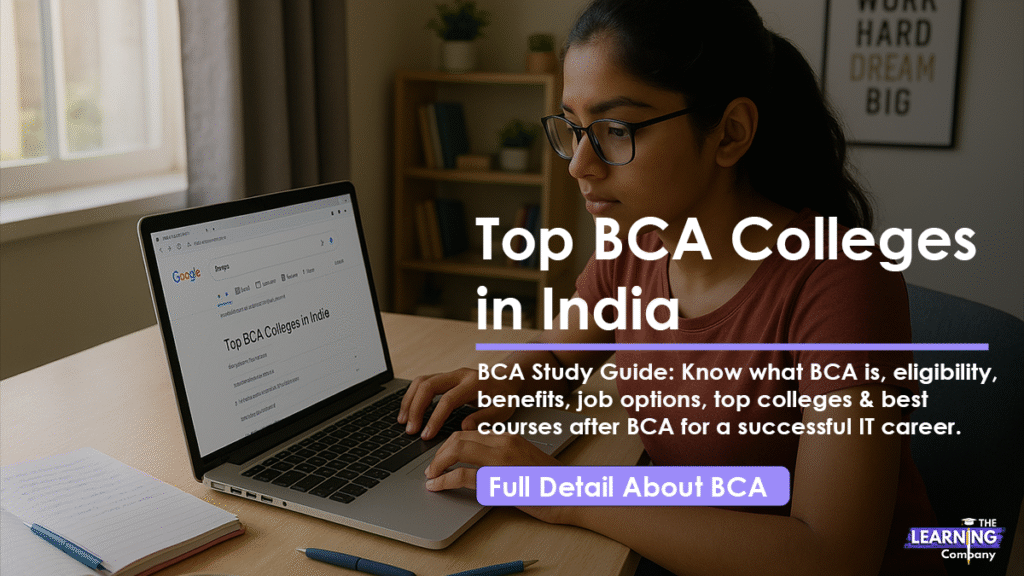
BCA Study Guide: BCA Course Eligibility, Top BCA Colleges in India

If you are looking for a career in IT and software development, this BCA Study Guide is for you. It covers everything — what BCA is, eligibility, job opportunities, salaries, and the best courses to take after BCA. Whether you are from Science, Commerce, or Arts, this guide will help you decide if BCA is the right path for you. Also, The Learning Company offers free career counselling for working professionals, helping you choose the right course and career plan based on your goals. What is BCA? BCA stands for Bachelor of Computer Applications. It is a three-year undergraduate course focused on computer programming, software development, and IT systems. This course is perfect for students who want to work as software developers, data analysts, IT consultants, or web designers. In this BCA Study Guide, we will explore not just what BCA is, but also how it can open doors to high-paying jobs and further studies. BCA Course Eligibility To apply for a BCA course, you must: Complete 10+2 (Class 12) from a recognized board. Many colleges allow students from any stream — Science, Commerce, or Arts. Some institutes may require Mathematics or Computer Science in Class 12. BCom Course Duration in Top BCom Colleges in India BCom course duration is 3 years, split into 6 semesters. Each semester has 4–5 core subjects that prepare you for various careers in commerce and business. Can Commerce Student Do BCA? Yes, commerce students can do BCA. Many colleges welcome students from non-science backgrounds. If you are comfortable with logical thinking and have an interest in computers, you can easily succeed in BCA. BCA Benefits Here are the main benefits of pursuing BCA: Affordable compared to engineering (B.Tech). Builds strong programming and analytical skills. Provides opportunities in IT, software, and government jobs. Acts as a foundation for advanced studies like MCA, MBA, or specialized IT certifications. Is BCA a Professional Course? Yes, BCA is a professional course because it equips you with skills required for specific careers in the IT industry. You don’t just learn theory — you gain hands-on experience with coding, databases, and software applications. Govt Jobs After BCA After completing your BCA, you can apply for several government jobs in IT, administration, and defense. Here’s a simplified overview of the top options: 1. Banking Sector (IBPS, SBI, RBI)| Roles: IT Officer, Clerk, Assistant Manager – ITEligibility: BCA with computer knowledgeSalary Range: ₹30,000 – ₹70,000 per monthExam: IBPS/SBI/RBI exams 2. Indian Railways (RRB) Roles: Data Entry Operator, Assistant ProgrammerEligibility: BCA degreeSalary Range: ₹35,000 – ₹60,000 per monthExam: RRB CBT + Skill Test 3. SSC (Staff Selection Commission) Roles: Data Processing Assistant, ProgrammerEligibility: BCA with computer skillsSalary Range: ₹35,000 – ₹75,000 per monthExam: SSC CGL / CHSL 4. Defense Sector (Army, Navy, Air Force) Roles: IT Officer, Technical SupportEligibility: BCA with age and physical fitness standardsSalary Range: ₹50,000 – ₹80,000 per monthExam: CDS / AFCAT / SSB Interview 5. UPSC (Union Public Service Commission) Roles: IAS, IPS, IFS, etc.Eligibility: BCA graduates can applySalary Range: ₹56,000 – ₹2.5 lakh per monthExam: UPSC Civil Services Exam 6. Public Sector Undertakings (PSUs) Organizations: BHEL, ONGC, BEL, etc.Roles: Software Engineer, Technical AssistantEligibility: BCA with technical skillsSalary Range: ₹35,000 – ₹70,000 per monthExam: GATE (sometimes) + Interview 7. ISRO, DRDO, NIC Roles: Programmer, Technical AssistantEligibility: BCA or equivalentSalary Range: ₹40,000 – ₹80,000 per monthExam: Written Test + Skill Test BBA or BCA: Which is Better? Criteria BBA BCA Course Focus Business & Management Computer Science & IT Duration 3 years 3 years Eligibility 10+2 (any stream) 10+2 (any stream) Career Options Manager, Marketing, HR Developer, IT Support Higher Studies MBA, M.Com MCA, M.Tech Starting Salary ₹2.5 – 5 LPA ₹2.5 – 6 LPA BBA is better if you want to focus on business, marketing, and management. BCA is better if you want to focus on technology and IT. BCA Study Guide This section summarizes how to approach BCA smartly: Understand the course structure and subjects. Choose the right college based on quality and fees. Plan your higher studies early (MCA, MBA, or certifications). Use resources like The Learning Company for free career counselling to stay on track. Can I Do BCA Without Maths? Yes, many colleges allow you to do BCA without Mathematics. However, having basic knowledge of maths can make programming and logical reasoning easier. Top BCA Colleges in India Here are some of the best BCA colleges with fee details: Amity University (Online) Fees per Semester: ₹25,000 Full Course Fee: ₹1,50,000 Discounted Fee: ₹1,42,500 Manipal University Jaipur Fees per Semester: ₹22,500 Full Course Fee: ₹1,35,000 Vivekanand Global University Without EBD: ₹19,000 per semester With EBD: ₹15,200 per semester Examination Fee: ₹1,500 per semester Full Course Fee (With EBD): ₹1,00,200 (including exam fees) Registration Fee: ₹1,000 Shoolini University Offer 1 (Pay After Placement): ₹10,500 × 6 = ₹90,000 Offer 2 (Standard): ₹12,500 × 6 = ₹75,000 Application Fee: ₹500 BCA Job Salary The average salary for BCA graduates in India ranges from ₹3–5 LPA. With experience, certifications, and advanced degrees like MCA or MBA, salaries can reach ₹8–12 LPA or even higher in specialized roles. After BCA Which Course is Best for High Salary? MCA: For advanced technical knowledge. MBA: For management roles. Data Science, Artificial Intelligence, or Cybersecurity certifications: For high-paying specialized roles. After BCA Which Course is Best? If you want to stay in technology, MCA is the best choice. If you want to move into leadership or business roles, MBA is ideal. You can also explore short-term certifications to upskill quickly. BCA Job Opportunities BCA opens doors to multiple roles in the IT industry: Software Developer Data Analyst Web Designer Network Administrator IT Consultant BCA Course Subjects List Some of the core subjects in BCA include: Computer Fundamentals Programming in C, C++, and Java Database Management Systems Data Structures Web Development Operating Systems How The Learning Company Helps The Learning Company provides resources and free career counselling for working professionals, helping you select the right college, course, and career path based on your

Scroll to Top

Book Free Counselling & Get Support for Your Education! 🎓✨

BOOK FREE COUNSELLING

Apply for Learnify Scholarship Aid & get financial support for your education! 🎓✨

Apply For Learnify Scholarship Aid